

At Miami Contact Lens Institute, we offer individualized solutions for presbyopia, including advanced multifocal contact lens designs for patients with more complex visual needs. Understanding the condition and available treatments can help you choose an approach that provides clear, comfortable vision at the distances that matter most to you.
What Is Presbyopia?
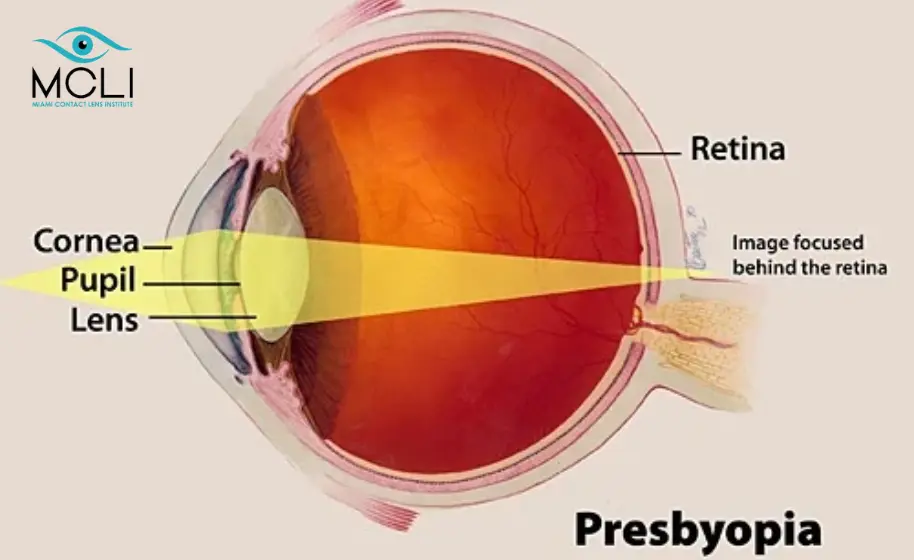
Presbyopia is an age-related reduction in the eye's ability to focus on nearby objects. It occurs as the natural crystalline lens gradually becomes less flexible, reducing the eye's ability to adjust its focusing power when looking from distant objects to those that are close. This focusing process, known as accommodation, normally allows us to transition between distance and near vision. When we look at something nearby, the ciliary muscle contracts, allowing the crystalline lens to become more rounded and increase its focusing power. As the lens becomes less flexible with age, it can no longer change shape sufficiently to maintain clear near vision.
Most people begin noticing presbyopia between approximately 40 and 45 years of age, although the timing varies depending on their existing prescription and visual demands. Someone who has never worn glasses may suddenly need reading glasses, while a person who already wears distance correction may begin requiring an additional prescription for near tasks. Presbyopia is different from myopia, hyperopia, and astigmatism, although these conditions can coexist. Unlike conventional refractive errors, which relate primarily to how light is focused by the eye's optical system, presbyopia specifically involves the gradual loss of accommodation.
Is Presbyopia a Normal Part of Aging?
Yes. Presbyopia is a normal physiological change that occurs as the crystalline lens ages. It is not caused by reading too much, using digital screens, or failing to exercise your eyes, and it does not necessarily indicate that your eyes are unhealthy. However, not every change in near vision should automatically be attributed to presbyopia. Other conditions, including uncorrected refractive error, dry eye disease, cataracts, and certain ocular or systemic disorders, can also affect visual clarity. A comprehensive eye examination can help determine whether your symptoms are related to presbyopia or another condition requiring attention.
What Are the Signs and Symptoms of Presbyopia?

Presbyopia develops gradually, and many people first notice symptoms during activities that require sustained near focus. The earliest changes may be subtle, particularly when lighting is good or the print is relatively large.
Common symptoms include:
- Difficulty reading small print: Text messages, menus, medication labels, and books may appear blurry at your usual reading distance.
- Holding objects farther away: Extending your arms may temporarily improve clarity by increasing the distance between your eyes and the object.
- Needing brighter lighting: Reading and other detailed tasks may become more difficult in dim environments.
- Eye strain during near work: Prolonged reading, computer use, or other close-up activities may become uncomfortable.
- Headaches after sustained visual tasks: Some patients experience headaches or fatigue when trying to maintain clear near vision.
- Difficulty transitioning between distances: Switching focus between a computer screen, printed documents, and distant objects may become less comfortable.
Symptoms often become more noticeable toward the end of the day or when you are tired. If near-vision difficulties begin interfering with your work or daily activities, an examination can help determine whether presbyopia is responsible and which correction would be most beneficial.
What Causes Presbyopia?
The primary cause of presbyopia is the gradual age-related loss of flexibility of the crystalline lens. In younger eyes, the lens can readily change shape to increase its focusing power for nearby objects. As the lens ages, its mechanical properties change, and it becomes progressively less capable of accommodating. The ciliary muscle generally retains the ability to contract, but the increasingly rigid lens cannot respond as effectively. As a result, the eye's available accommodative amplitude decreases, making it more difficult to focus clearly at normal reading distances. Presbyopia develops gradually over many years, although most people do not become aware of it until their remaining focusing ability is insufficient for their everyday visual demands.
Can Presbyopia Develop Earlier Than Age 40?
Although presbyopia typically becomes symptomatic in the early to mid-40s, some individuals notice near-vision difficulties earlier. People with uncorrected hyperopia, for example, may experience symptoms sooner because they must use additional accommodation even when looking at distant objects. Near-vision difficulties in younger adults can also result from accommodative dysfunction, binocular vision disorders, medication effects, or other ocular and systemic conditions. These symptoms should not automatically be classified as premature presbyopia.
If you experience persistent difficulty focusing at near distances before your 40s, a comprehensive examination can help identify the underlying cause and determine whether treatment is needed.
How Is Presbyopia Diagnosed?
Presbyopia is diagnosed during a comprehensive eye examination that evaluates your distance and near vision, refractive error, focusing ability, and overall ocular health. Your optometrist will also consider your daily visual activities, since the amount of near correction needed can vary depending on whether you primarily read printed material, use a computer, or perform detailed close-up work.
Comprehensive Eye Examination
The examination begins with a review of your symptoms, current prescription, medical history, and visual demands. Your optometrist will assess how clearly you see at different distances and determine whether your symptoms are consistent with age-related changes in accommodation.
Refraction and Near-Vision Assessment
Refraction testing identifies the prescription needed to optimize distance vision and determines whether myopia, hyperopia, or astigmatism is present. Near-vision testing then helps establish the additional focusing power, commonly called the near addition or ADD, required for comfortable reading and other close-up activities. Your ideal near prescription depends on your working distance and the tasks you perform. Someone who spends much of the day using a computer may benefit from a different correction than someone whose primary concern is reading small print.
Evaluation of Ocular Health
A comprehensive examination also includes an assessment of ocular health to identify other conditions that may contribute to blurred vision. This may include examination of the cornea, tear film, crystalline lens, retina, and other ocular structures. Because conditions such as dry eye disease and early cataracts can affect visual quality, identifying and managing these issues is an important part of developing an effective treatment plan.
Presbyopia Treatment Options
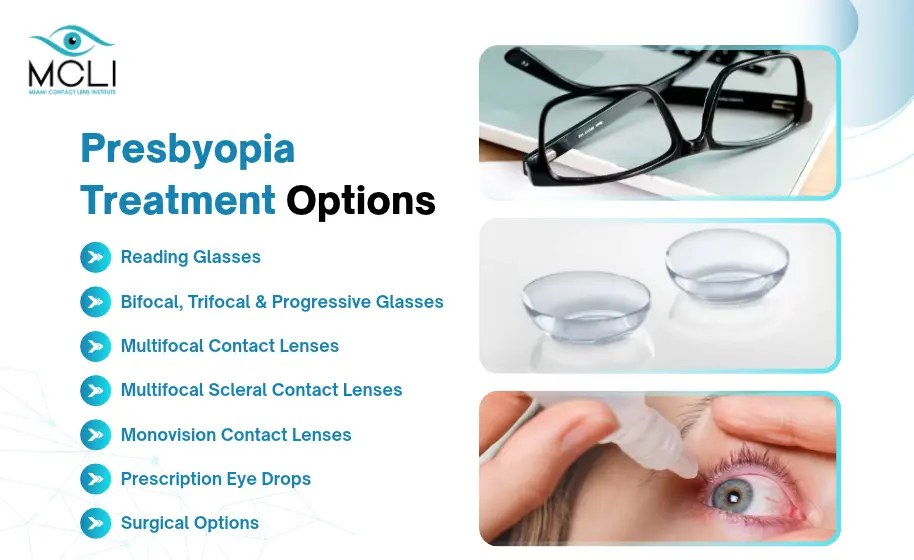
Presbyopia cannot currently be reversed through conventional treatment, but several options can compensate for the loss of accommodation and improve near vision. The most appropriate approach depends on your prescription, eye health, lifestyle, and preferences regarding glasses or contact lenses.
Reading Glasses
Reading glasses are one of the simplest and most effective ways to manage presbyopia. They provide additional plus power to help focus on nearby objects, making activities such as reading, using a phone, or performing detailed tasks more comfortable. Over-the-counter reading glasses may be sufficient for people who have good uncorrected distance vision and similar near-vision requirements in both eyes. However, prescription reading glasses may provide better results when astigmatism, unequal prescriptions, or specific working distances need to be considered. The main limitation is that reading glasses are generally designed for near tasks and may need to be removed when looking at distant objects.
Bifocal, Trifocal, and Progressive Glasses
For patients who require correction at multiple distances, multifocal eyeglasses can provide a more convenient alternative to switching between separate pairs. Bifocal lenses contain distinct distance and near correction zones, while trifocal lenses add an intermediate zone for activities such as computer work. Progressive addition lenses provide a gradual change in optical power from distance through intermediate to near vision without visible dividing lines. Progressive lenses are popular because they allow correction at several distances within a single pair of glasses. However, some patients require an adaptation period, and the available visual field may vary depending on the lens design.
Multifocal Contact Lenses
Multifocal contact lenses are an excellent option for patients who want to reduce their dependence on reading glasses while maintaining functional vision at distance, intermediate, and near. Unlike single-vision contact lenses, multifocal designs incorporate different optical powers or zones that allow the visual system to access information from multiple distances. These designs may use simultaneous-vision optics, in which distance and near images are presented to the eye at the same time. Modern multifocal contact lenses are available in a variety of materials and designs, including daily disposable, reusable soft, and rigid gas-permeable options. Certain designs can also accommodate astigmatism or more complex refractive requirements.
Successful multifocal contact lens fitting requires more than selecting the correct prescription. Lens centration, pupil size, ocular surface health, tear film stability, and individual visual demands can all influence performance. Some patients may experience reduced contrast sensitivity, halos, or differences in visual quality, particularly in low-light conditions. At Miami Contact Lens Institute, we specialize in individualized contact lens fittings, including advanced multifocal designs for patients who have not achieved satisfactory results with conventional contact lenses.
Multifocal Scleral Contact Lenses
For patients with presbyopia who also have irregular corneas, significant dry eye disease, or difficulty tolerating conventional contact lenses, multifocal scleral lenses may provide an additional option. Scleral contact lenses are large-diameter rigid gas-permeable lenses that vault over the cornea and rest on the sclera. The fluid reservoir beneath the lens helps maintain hydration of the corneal surface while the rigid optical design can improve vision affected by corneal irregularity.
Multifocal optics can be incorporated into selected scleral lens designs to provide additional near correction. This may be particularly beneficial for patients with keratoconus, post-surgical corneal irregularities, or ocular surface disease who also require presbyopic correction. However, multifocal scleral lenses require careful customization, and not every patient will achieve equally clear vision at all distances. Lens centration, optical zone design, pupil characteristics, and the patient's visual priorities must be considered during fitting.
Monovision Contact Lenses
Monovision is another approach to correcting presbyopia with contact lenses. Typically, one eye is corrected primarily for distance vision while the other is corrected for near vision, allowing the brain to use information from each eye for different tasks. Some patients adapt well to monovision and appreciate the reduced need for reading glasses. However, the difference in correction between the eyes can affect binocular vision, stereopsis, and visual performance in certain situations, particularly at night.
A contact lens trial is often recommended before committing to monovision so that patients can evaluate how well the approach works during their normal daily activities.
Prescription Eye Drops for Presbyopia
Prescription eye drops have introduced a nonsurgical option for temporarily improving near vision in selected adults with presbyopia. Most currently available presbyopia drops work primarily by constricting the pupil, creating a pinhole effect that increases depth of focus. By reducing the effective pupil size, these medications can improve near visual acuity without physically restoring the crystalline lens's youthful flexibility. The degree and duration of improvement depend on the medication, the patient's baseline prescription, and individual response.
One example is aceclidine ophthalmic solution 1.44%, marketed as VIZZ, which received FDA approval in 2025 for the treatment of presbyopia in adults. Clinical studies have demonstrated improvement in near visual acuity, with effects that may last for several hours in some patients. Other prescription miotic medications have also been developed for presbyopia. These treatments may be useful for patients who want temporary improvement in near vision without relying on reading glasses throughout the day.
However, prescription drops are not appropriate for everyone. Potential side effects can include headache, eye irritation, redness, reduced vision in dim lighting, and other medication-specific risks. Rare but important retinal complications have been reported with certain miotic medications, making appropriate patient selection and retinal evaluation particularly important. Patients should discuss the benefits, limitations, and safety considerations of these medications with their eye care provider before beginning treatment.
Surgical Options for Presbyopia
Certain surgical procedures can reduce dependence on reading glasses, although no surgical approach is ideal for every patient.
Laser vision correction may be used to create monovision by correcting one eye primarily for distance and the other for near. Refractive lens exchange involves removing the natural crystalline lens and replacing it with an intraocular lens, which may incorporate multifocal, extended-depth-of-focus, or other optical designs. For patients who already have visually significant cataracts, cataract surgery with an appropriately selected intraocular lens may also provide an opportunity to address presbyopic visual needs.
These procedures have different benefits and risks, including potential effects on contrast sensitivity, glare, halos, depth perception, and overall visual quality. Intraocular surgery also carries additional risks that must be considered carefully. A comprehensive evaluation is necessary to determine whether a surgical approach is appropriate, particularly for patients with ocular surface disease, retinal conditions, or other factors that may affect postoperative visual outcomes.
What Happens If Presbyopia Is Left Untreated?
Presbyopia itself does not cause permanent damage to the eyes, and choosing not to wear reading glasses will not accelerate the aging process of the crystalline lens. However, uncorrected presbyopia can make everyday activities increasingly frustrating. Reading small print, working on a computer, using a phone, or performing detailed tasks may require greater effort and lead to visual fatigue or discomfort. Some patients compensate by holding reading material farther away or increasing lighting, but these strategies become less effective as accommodation continues to decline.
Appropriate correction can improve visual comfort, efficiency, and quality of life without changing the underlying age-related process.
Presbyopia Treatment at Miami Contact Lens Institute
Presbyopia affects nearly everyone eventually, but finding the right correction does not have to mean giving up the convenience of contact lenses or accepting compromised vision. At Miami Contact Lens Institute, we take an individualized approach to presbyopia management, considering each patient's prescription, ocular health, lifestyle, and visual priorities. While reading glasses and progressive lenses remain effective options, our practice has particular expertise in advanced contact lens designs for patients seeking greater independence from glasses.
Dr. Elise Kramer, OD, FAAO, FSLS, FBCLA, specializes in complex contact lens fitting and ocular surface disease, including multifocal soft lenses, rigid gas-permeable lenses, and customized scleral lens designs. This expertise is especially valuable for patients with astigmatism, dry eye disease, irregular corneas, or previous difficulty adapting to multifocal contact lenses. Whether you're beginning to notice changes in your near vision or are dissatisfied with your current correction, a comprehensive evaluation can help identify an approach that supports your daily visual needs.
Contact Miami Contact Lens Institute to schedule a presbyopia consultation and explore your options for clearer, more comfortable vision at every distance.